ICG-Guided Thyroid and Parathyroid Surgery - How Fluorescence Is Making Operations Safer?
Thyroid surgery is one of the most commonly performed operations in head and neck surgery. It is also one where a very small mistake damaging or accidentally removing a parathyroid gland can have consequences that last a lifetime. ICG-guided surgery was developed to prevent exactly that. It gives the thyroid surgeon real-time visual information that was simply not available before and it is changing outcomes in meaningful, measurable ways.
The Biggest Risk in Thyroid Surgery And How ICG Addresses It
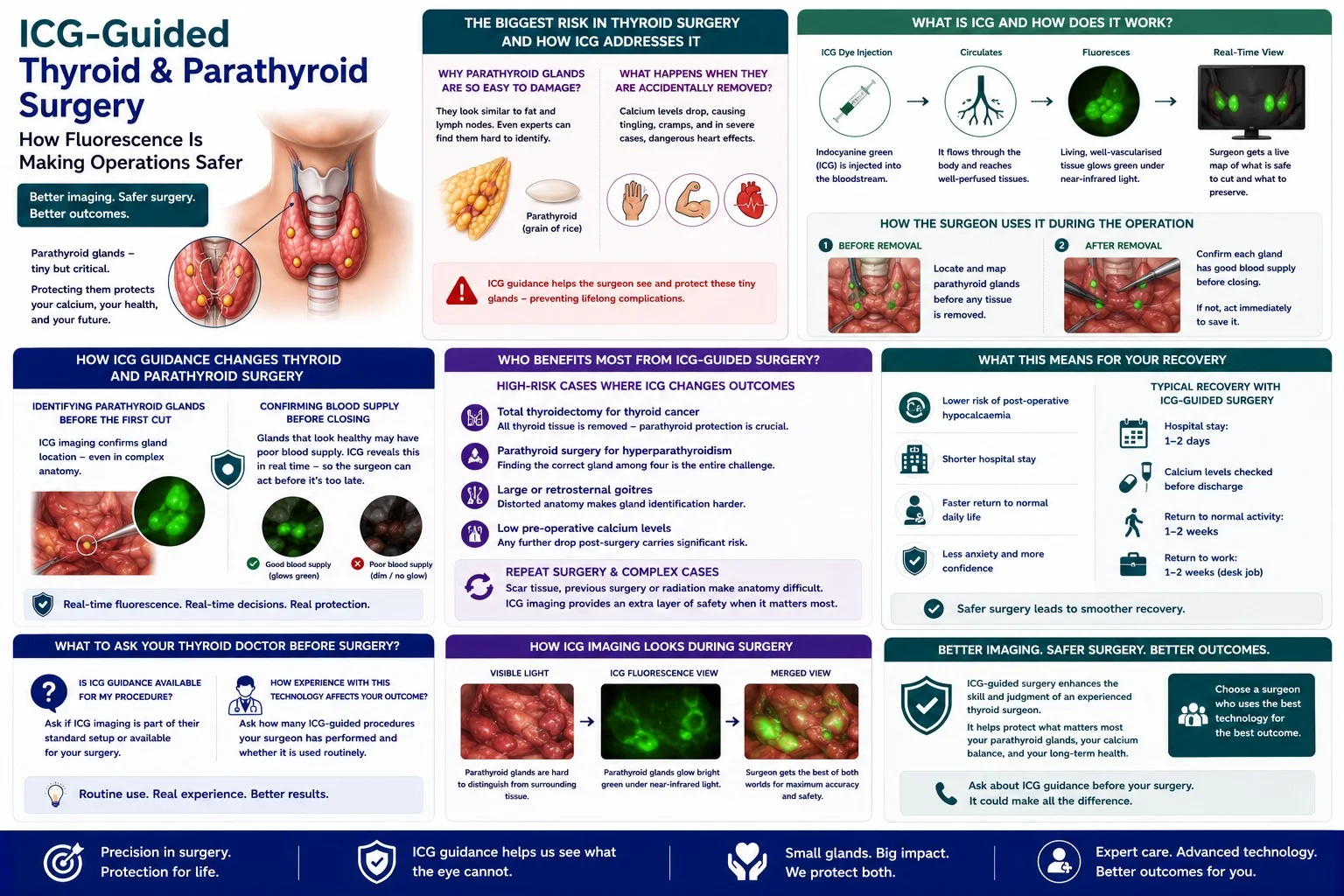
The parathyroid glands are four tiny structures each roughly the size of a grain of rice that sit behind or around the thyroid gland. They control calcium levels in the blood, which affects everything from muscle function to heart rhythm to bone health.
Why Parathyroid Glands Are So Easy to Damage?
The problem is that parathyroid glands look almost identical to surrounding fat tissue and lymph nodes. Even an experienced thyroid surgeon operating under magnification can find them difficult to identify with certainty. In complex cases large goitres, cancerous thyroids, or repeat surgery this becomes even more challenging.
What Happens When They Are Accidentally Removed?
When one or more parathyroid glands are damaged or removed during thyroid surgery, calcium levels drop. This causes tingling, muscle cramps, and in severe cases, dangerous cardiac effects. Patients may need lifelong calcium and vitamin D supplementation. ICG guidance was introduced specifically to prevent this outcome.
What Is ICG and How Does It Work?
ICG stands for indocyanine green a fluorescent dye that has been used safely in medicine for decades. When injected into the bloodstream during surgery, it circulates through the body and causes living, well-vascularised tissue to glow bright green under a special near-infrared camera.
The Dye That Lights Up Living Tissue in Real Time:
The parathyroid glands, when their blood supply is intact, glow clearly under ICG imaging. Tissue that has lost its blood supply or tissue that is not parathyroid at all does not glow. This gives the thyroid surgeon a live, colour-coded map of what is safe to cut and what must be preserved.
How the Surgeon Uses It During the Operation?
ICG imaging is used at two key moments. First, before any tissue is removed to locate the parathyroid glands and map their position relative to the thyroid. Second, after the thyroid has been removed to confirm that each parathyroid gland still has a functioning blood supply before the wound is closed. If a gland shows poor perfusion, the surgeon can act immediately rather than discovering the problem post-operatively.
How ICG Guidance Changes Thyroid and Parathyroid Surgery?
Identifying Parathyroid Glands Before the First Cut
In conventional parathyroid surgery and thyroid surgery, gland identification relies on visual recognition and the surgeon’s experience alone. With ICG, identification is confirmed by imaging reducing the chance of error even in the most challenging anatomical situations.
Confirming Blood Supply Before Closing
This is the step that makes the biggest clinical difference. A parathyroid gland that looks intact to the naked eye may have compromised blood supply that will cause it to fail post-operatively. ICG imaging reveals this in real time giving the surgeon the chance to reposition, reimplant, or protect the gland before the patient wakes up.
Who Benefits Most From ICG-Guided Surgery?
ICG guidance adds value in any thyroid or parathyroid operation, but it makes the greatest difference in higher-risk cases.
High-Risk Cases Where ICG Changes Outcomes
- Total thyroidectomy for thyroid cancer where all thyroid tissue is removed and parathyroid preservation is critical
- Parathyroid surgery for hyperparathyroidism where identifying the correct gland among four is the entire surgical challenge
- Large or retrosternal goitres where distorted anatomy makes parathyroid identification harder
- Patients with low pre-operative calcium where any further drop post-surgery carries significant risk
Repeat Surgery and Complex Cases:
Patients undergoing a second operation on the thyroid or neck after previous surgery or radiation face anatomy that is heavily scarred and difficult to navigate. ICG imaging provides an additional layer of safety in exactly these situations, where experience alone is not always enough.
What This Means for Your Recovery?
The practical impact of ICG-guided thyroid surgery on recovery is significant.
Lower rates of post-operative hypocalcaemia mean fewer patients need emergency calcium treatment after surgery, shorter hospital stays, and a faster return to normal daily life. The anxiety of waiting to see whether calcium levels hold a common source of post-surgical stress for thyroid patients is reduced when the surgeon has already confirmed parathyroid function before closing.
Most patients undergoing ICG-guided thyroid surgery are discharged within one to two days. Blood tests confirm calcium stability before discharge, and most return to work and routine within one to two weeks.
What to Ask Your Thyroid Doctor Before Surgery?
Not all surgical centres offer ICG guidance, and not all surgeons are equally experienced with the technology. These are the questions worth asking before your operation.
Is ICG Guidance Available for My Procedure?
Ask your thyroid doctor directly whether ICG imaging is part of their standard surgical setup or available on request. In centres where it is routinely used, it is simply part of how surgery is done not an add-on.
How Experience With This Technology Affects Your Outcome?
ICG imaging is a tool. Its value depends on the surgeon’s ability to interpret what they are seeing and act on it in real time. Ask how many ICG-guided thyroid and parathyroid procedures your thyroid surgeon has performed, and whether they use it routinely or only in selected cases. Routine use reflects genuine integration into surgical practice which is where the consistent outcomes come from.
Better Imaging. Safer Surgery. Better Outcomes.
ICG-guided surgery does not replace surgical skill. It enhances it giving even the most experienced thyroid surgeon information that the human eye alone cannot provide. For patients facing thyroid or parathyroid surgery, it represents a meaningful step forward in safety. Ask about it before your operation. The right thyroid doctor will not only know what it is they will already be using it.