PET-CT, MRI, or Biopsy -
Which One Actually Tells You If It Is Head & Neck Cancer?
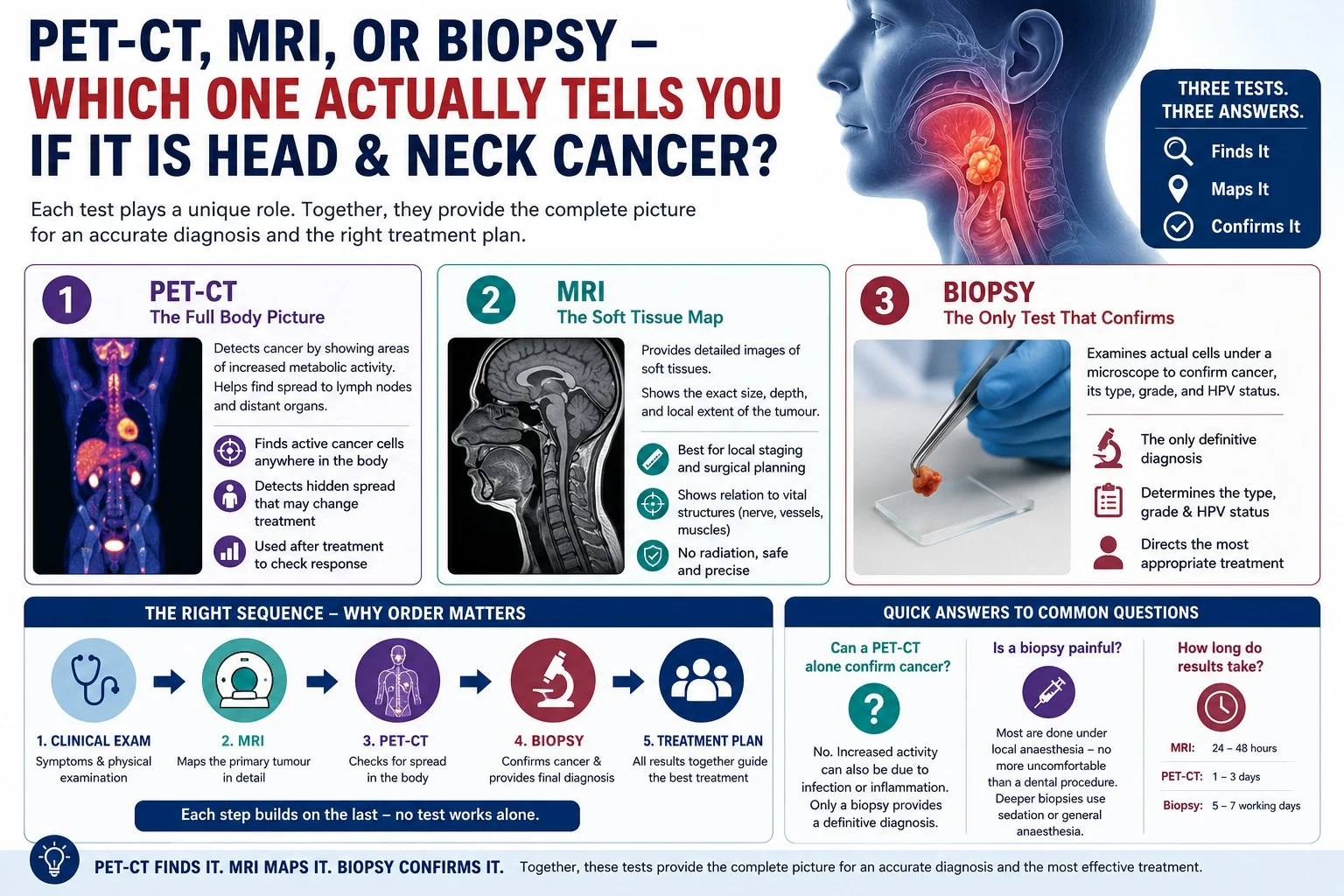
When a doctor orders a PET-CT, then an MRI, and then says a biopsy is also needed most patients feel one thing: confusion. Are all these tests saying the same thing? Why cannot one scan just give the answer? The truth is each test does something completely different. Understanding what each one contributes turns a bewildering process into a logical, step-by-step investigation.
These Three Tests Are Teammates - Not Alternatives
PET-CT, MRI, and biopsy are not competing options. Each one answers a question the others cannot. The process moves from broad to specific from mapping the body, to detailing the anatomy, to examining the cells. None of them can do the job alone.
MRI - The Soft Tissue Map
MRI uses magnetic fields to produce detailed images without radiation. Its strength is in separating different types of soft tissue muscle, nerve, blood vessel, and tumour with precision no CT scan can match. For cancers involving the tongue, floor of the mouth, throat, or salivary glands, MRI is the gold standard for surgical planning.
It tells the surgeon exactly where the tumour is, how deep it goes, and which structures it is adjacent to. What it cannot do is confirm the tissue is malignant. A tumour on MRI looks like a tumour but so does an inflammatory mass or a benign growth. MRI maps the territory. It does not identify the enemy.
PET-CT - The Full Body Picture
While MRI looks at anatomy, PET-CT looks at metabolic activity. A small amount of radioactive glucose i-s introduced into the bloodstream. Cancer cells which consume glucose far faster than normal cells absorb the tracer and light up on the scan. The CT component overlays the body’s anatomy, showing precisely where that activity is occurring.
This makes PET-CT uniquely powerful for detecting spread to lymph nodes or distant organs a finding that can completely change the treatment plan. It is also used after treatment to check whether the tumour has responded. A post-treatment PET-CT showing no residual activity is one of the most reassuring results a patient can receive.
Biopsy - The Only Test That Confirms Cancer
Everything before this point builds a case. The biopsy delivers the verdict.
No imaging test however sophisticated can confirm cancer. Only a pathologist examining actual tissue under a microscope can do that. Until that examination is complete, every finding remains a suspicion, however strong.
Types of Biopsy Used in Head and Neck Cancer:
- Incisional Biopsy – A small tissue sample taken from a visible oral lesion
- FNAC – A fine needle draws cells from a neck lump; quick, outpatient, minimally uncomfortable
- Endoscopic biopsy – Used for deeper throat or larynx lesions under sedation
The biopsy report confirms whether cancer is present, identifies the type, grades the tumour, and in relevant cases tests for HPV status. This report directly determines which treatment is most appropriate. Without it, no treatment plan can be finalised.
The Right Sequence - Why Order Matters
Clinical examination comes first. Imaging follows MRI for local detail, PET-CT for body-wide mapping. Biopsy is then performed guided by imaging findings. This sequence is not arbitrary. Each step informs the next, and getting the order right avoids unnecessary procedures and speeds up diagnosis.
By the time all three results are in, the oncology team has a complete picture where the cancer is (MRI), whether it has spread (PET-CT), and exactly what type it is (biopsy). Together, these three answers determine the entire treatment plan.
Quick Answers to Common Questions
Can a PET-CT alone confirm cancer?
No. Metabolic activity can also be elevated in infection or inflammation. Only a biopsy provides a definitive diagnosis.
Is a biopsy painful?
Most are performed under local anaesthesia no more uncomfortable than a dental procedure. Deeper biopsies use sedation or general anaesthesia.
How long do results take?
MRI 24 to 48 hours. PET-CT one to three days. Biopsy five to seven working days.
PET-CT Finds It. MRI Maps It. Biopsy Confirms It.
That is the sequence. That is the logic. Understanding it does not just reduce anxiety it helps you ask better questions, make more informed decisions, and engage more fully with the team working to give you the most accurate diagnosis possible.