
Can Smoking Cause Mouth Cancer?
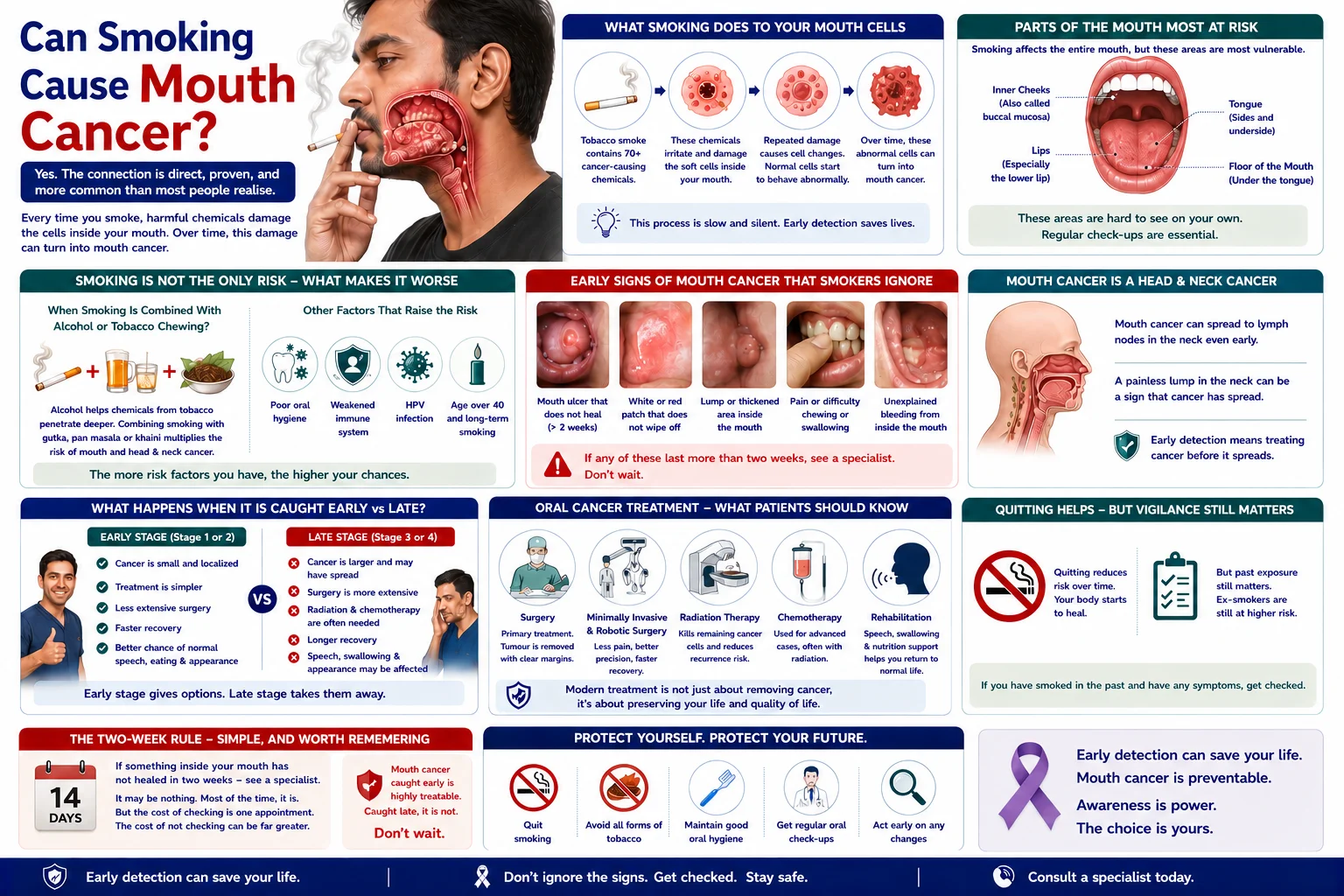
Yes and the connection is direct, proven, and more common than most people realise. Every time you smoke, the inside of your mouth is exposed to harmful chemicals that damage the cells lining your lips, tongue, cheeks, and gums. Over time, that damage adds up. And in some people, it leads to mouth cancer.
This is not about blame. It is about understanding what is happening inside your body so you can act before it becomes serious.
What Smoking Does to the Cells Inside Your Mouth?
Tobacco smoke does not just pass through. It sits on the soft tissue inside your mouth, carrying over 70 known cancer-causing chemicals. These chemicals irritate the cell lining again and again, every single time you smoke.
At first, the body tries to repair this damage on its own. But when the damage keeps coming, the repair process starts to go wrong. Normal cells begin to behave abnormally. They grow faster than they should. They stop responding to the body’s signals to stop. This is how mouth cancer begins not suddenly, but slowly, quietly, over months or years.
The Parts of the Mouth Most at Risk
Smoking affects the entire oral cavity, but certain areas take more damage than others. The floor of the mouth, the underside of the tongue, the inner cheeks, and the lips are the sites where tobacco-related mouth cancer most commonly develops. These are also areas that are difficult to see on your own which is one reason why the disease is often found late.
Smoking Is Not the Only Risk – What Makes It Worse
Smoking alone raises the risk significantly. But in India, many people combine smoking with other habits that multiply that risk even further.
When Smoking Is Combined With Alcohol or Tobacco Chewing?
Using tobacco and alcohol together does not just add the two risks it multiplies them. Alcohol makes the cells of the mouth lining more permeable, allowing the chemicals in tobacco to penetrate deeper and cause more damage. Similarly, combining cigarette smoking with gutka, pan masala, or khaini keeps the mouth in a state of near-constant chemical exposure. This combination is one of the strongest known risk factors for mouth cancer and head and neck cancer in India.
Other Factors That Raise the Risk:
Poor oral hygiene, a weakened immune system, and HPV infection can all increase the likelihood that tobacco-related cell damage progresses to cancer. Age also matters the risk is higher in people over 40 who have been smoking for many years. But mouth cancer is being diagnosed in younger people too, particularly those who combine smoking with other tobacco habits.
Early Signs of Mouth Cancer That Smokers Ignore
Most people notice something small and wait. A sore that does not heal, a rough patch, a slight discomfort when eating. They tell themselves it will pass. Sometimes it does. But when it does not, every week of waiting matters.
The Mouth Ulcer That Will Not Heal
A mouth ulcer that has been present for more than two weeks without healing is the single most important warning sign to act on. A normal ulcer heals within seven to ten days. One that stays beyond two weeks especially in a smoker needs to be seen by a specialist. Not a chemist. Not a general physician with a gel prescription. A specialist.
Other Changes That Should Not Be Ignored
- A white or red patch inside the cheek, on the tongue, or on the gums that does not wipe off
- A lump or thickened area inside the mouth
- Pain or difficulty when chewing or swallowing
- A feeling that something is stuck in the mouth or throat
- Unexplained bleeding from inside the mouth
None of these feel dramatic at first. That is exactly the problem. Mouth cancer in its early stages is quiet. It does not announce itself. Which is why these small signs deserve serious attention.
Mouth Cancer Is a Head and Neck Cancer - Why That Matters
Mouth cancer is classified as a type of head and neck cancer a group of cancers that affect the oral cavity, throat, voice box, salivary glands, and nearby structures. Understanding this matters because head and neck cancer, including mouth cancer, can spread to the lymph nodes in the neck relatively early. A lump in the neck painless and persistent is sometimes the first sign that mouth cancer has already moved beyond its original site.
This is why early detection is not just about finding a smaller tumour. It is about finding the cancer before it has had the chance to spread
What Happens When It Is Caught Early vs Late?
This is where timing changes everything not just medically, but in terms of quality of life.
When mouth cancer is found at Stage 1 or 2, treatment is usually straightforward. The area involved is small, the procedure is less extensive, and recovery is faster. Most patients go on to live normal lives with full speech and swallowing function preserved.
When it is found at Stage 3 or 4, the situation is more complex. Surgery becomes more extensive. Radiation and chemotherapy are often added. Recovery takes longer. And the impact on how a person speaks, eats, and looks can be significant.
The early stage gives options. The late stage takes them away. That is not meant to frighten it is meant to be honest.
Oral Cancer Treatment - What Patients Should Know
Oral cancer treatment has advanced significantly. Surgery remains the primary treatment for most cases removing the tumour with clear margins to reduce the risk of it returning. For early-stage cancers, this can often be done through minimally invasive or even robotic approaches that preserve function and reduce recovery time.
For more advanced cases, surgery is typically followed by radiation therapy, chemotherapy, or both. This combined approach has improved survival outcomes considerably over the last decade.
Equally important is rehabilitation speech therapy, swallowing therapy, and nutritional support that help patients return to daily life after treatment. Modern oral cancer treatment is not just about removing disease. It is about preserving the life the patient wants to return to.
Quitting Helps - But Vigilance Still Matters
Quitting smoking reduces the risk of mouth cancer over time. The body begins to repair some of the damage, and the ongoing chemical exposure stops. This is always worth doing at any age, at any stage of the habit.
But quitting does not erase the years of exposure that have already occurred. Ex-smokers still carry a higher lifetime risk than people who never smoked. Which means the warning signs in this blog apply to you whether you still smoke today or stopped years ago.
If you have smoked for any significant period and notice any of the signs described here do not assume you are in the clear just because you have quit. Get it checked. Early action is the one decision that genuinely changes outcomes in mouth cancer.
The Two-Week Rule - Simple, and Worth Remembering
If something inside your mouth has not healed in two weeks see a specialist. Not next month. This week.
It may be nothing. Most of the time, it is. But the cost of checking is a single appointment. The cost of not checking if it turns out to be something can be far greater. Mouth cancer caught early is highly treatable. Mouth cancer caught late is not. That difference begins with one decision, made before two weeks becomes two months.